Showing posts with label Sam Payne. Show all posts
Showing posts with label Sam Payne. Show all posts
Monday, 8 November 2010

Sunday, 7 November 2010
Children's Film: Editing Day 3
We finished the editing process today. All the cuts were finished yesterday, so we added in the transitions and music and sound effects. We decided to put all of the audio files into one Garageband file so that we could simply cut it in Final Cut Express, and would prevent us from having to import multiple files. Credits and a title have also been added giving the names of Director, Producer, Editor etc.
Now that the editing process is complete we have our footage cut and flowing, with credits, music and sound effects all at appropriate times. We have made sure that the music/sound effects doesn't overpower the dialogue parts of the sequence, and have decided to subtly lower the music when dialogue begins.
I mentioned earlier, in a post here, that we would have to check that the classification of the film. Going back to our post on classification, we have decided that the best classification for our opening sequence is PG. Earlier I thought that we may need to change the classification to U, however, looking back at the classification rules PG is more suitable. This is because the threats represented by the villain show no outcome, and mild discrimination is shown in the reality school scene when the apple is thrown out of Jeremy's hand. Therefore PG is more suitable, and it's better to choose this classification to be safe.
Note: Our classification is PG.
Now that the editing process is complete we have our footage cut and flowing, with credits, music and sound effects all at appropriate times. We have made sure that the music/sound effects doesn't overpower the dialogue parts of the sequence, and have decided to subtly lower the music when dialogue begins.
 |
| Adding credits |
I mentioned earlier, in a post here, that we would have to check that the classification of the film. Going back to our post on classification, we have decided that the best classification for our opening sequence is PG. Earlier I thought that we may need to change the classification to U, however, looking back at the classification rules PG is more suitable. This is because the threats represented by the villain show no outcome, and mild discrimination is shown in the reality school scene when the apple is thrown out of Jeremy's hand. Therefore PG is more suitable, and it's better to choose this classification to be safe.
Note: Our classification is PG.
Tuesday, 2 November 2010
Children's Film: Editing Day 2
 |
| Adding a Transition. |
Well on schedule, but in our final editing day we need to consider the following: credits at the opening, importing soundtrack and sound effects, adding more transitions and adding any other finishing touches to the sequence.
Monday, 1 November 2010
Children's Film: Editing Day 1
Today we began our editing process, and also began to create the music the soundtrack and sound effects for our sequence.
The most important thing which we began to do today was cutting the footage up. This ensured that we had a flowing sequence of different shots, this will enable us to add in any transitions of effects that we need later. The footage was originals about 6 minutes in total as we had filmed the same shots several times to ensure that we got the best we could, after finishing all the cutting we have about 2 - 3 minutes. Our aim is to get the opening sequence as close to 2 minutes as possible.
 |
| Cut footage |
 |
| Editing the Time-line. |
Tuesday, 19 October 2010
Children's Film: Filming Day 2
During filming day two we completed our the rest of the filming. As we have completed the superhero scene, in which the main character is dreaming, we are now able to move onto reality in a school environment. In the filming on day two we were able to film the classroom scene, where our main character wakes up from his dream. We then see a short corridor scene, which includes the 'apple' which we saw in the previous superhero scene. This will enable the audience to see that this character is in-fact the same character as before - just in a different situation/scene. During the corridor scene the apple is destroyed by an by-passer which shows the destruction of hope for the main character. The opening sequence ends shortly after this.
Overall we managed to complete this quickly as the shots were fairly short. We have tried to use a variety of angles to show hierarchy between the teacher and student, we have also used panning, and some different shot distances. From both days of filming I believe that we have used a huge variety of techniques which will make the opening sequence more interesting for the young audience.
We finished the filming day by importing/capturing our footage from the camera onto the computer, which we will be editing in upcoming lessons.
Overall we managed to complete this quickly as the shots were fairly short. We have tried to use a variety of angles to show hierarchy between the teacher and student, we have also used panning, and some different shot distances. From both days of filming I believe that we have used a huge variety of techniques which will make the opening sequence more interesting for the young audience.
We finished the filming day by importing/capturing our footage from the camera onto the computer, which we will be editing in upcoming lessons.
Monday, 18 October 2010
Children's Film: Filming Day 1
Today we began filming our children's film opening sequence. So far we are right on schedule and have been able to finish all of our superhero scene. We were very careful to follow our plan as closely as possible, and tried to use a wide range of angles and locations.
Before our filming began we sorted out the costumes, which I have posted about here. We all brought in a range of different items to create the costumes, which I think have turned out really well.
From filming today I think that our classification might need to be changed from PG to U. This is because we have not used any discrimination and have used minimal violence, and so I believe that the opening sequence would better fit into the U classification. We will later confirm this.
Before our filming began we sorted out the costumes, which I have posted about here. We all brought in a range of different items to create the costumes, which I think have turned out really well.
From filming today I think that our classification might need to be changed from PG to U. This is because we have not used any discrimination and have used minimal violence, and so I believe that the opening sequence would better fit into the U classification. We will later confirm this.
Children's Film: Costumes
As earlier discussed we need to create some costumes for our superhero and villain. Today we all brought in superhero items and possible costumes parts to dress our actors in. We also remembered to get the 'magic-apple' ready for filming on both days, and also the burger which we would need for the villain.
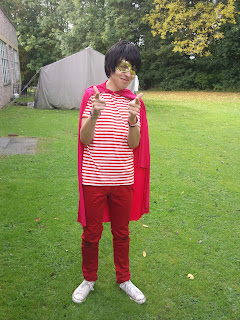 On the right you can see a photo of our superhero. The clothing is very bright coloured, this will immediately engage and attract the young audience. It also follows a theme of red and white, these are colors which the audience can then relate to later. It might even relate well to the apple which is also typically red. The superhero also wears a gold mask, this protects his identity without completely covering his face, the young children will be able to understand who this character is later on when he's out of this dream. The cape is quite a stereotypical part of a superhero costume, for example, like Superman. Some young children will immediately relate our superhero with Superman, and for some this might even be the item of clothing that disguises them as a superhero. Our actor, George, is also wearing a wig. The reason for this is that later the superhero will be seen as an everyday student, but he's a bit of an outsider and so we are using this wig so he is easily distinguishable.
Later our superhero exits the scene, and will still be wearing the wig so that the young audience can remember who this character is. It's extremely important that we make the transition from the superhero scene to the real-life scene as smooth and obvious as possible, or at least as evil.
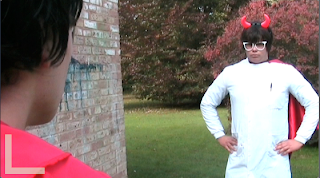 We also had a villain, he is wearing a evil-scientist style lab coat, glasses, devil horns, and a black cape which create this 'Dr Evil' effect. The devil horns are probably the item which make tell the audience that this is a villain. This scientist-style look is very stereotypical of villains. Frankenstein is an example, however small children are extremely unlikely to have watched this. The villain's weapon is a burger, this is crucial to our plot as it teaches a moral - healthy eating.
Later on our villain will be reusing the lab coat and glasses when he plays a teacher character. Again the audience will be able to relate to where the main character got this dream from.
 On the right you can see a photo of our superhero. The clothing is very bright coloured, this will immediately engage and attract the young audience. It also follows a theme of red and white, these are colors which the audience can then relate to later. It might even relate well to the apple which is also typically red. The superhero also wears a gold mask, this protects his identity without completely covering his face, the young children will be able to understand who this character is later on when he's out of this dream. The cape is quite a stereotypical part of a superhero costume, for example, like Superman. Some young children will immediately relate our superhero with Superman, and for some this might even be the item of clothing that disguises them as a superhero. Our actor, George, is also wearing a wig. The reason for this is that later the superhero will be seen as an everyday student, but he's a bit of an outsider and so we are using this wig so he is easily distinguishable.
Later our superhero exits the scene, and will still be wearing the wig so that the young audience can remember who this character is. It's extremely important that we make the transition from the superhero scene to the real-life scene as smooth and obvious as possible, or at least as evil.

Later on our villain will be reusing the lab coat and glasses when he plays a teacher character. Again the audience will be able to relate to where the main character got this dream from.
Children's Film: Health & Safety (Filming)
Here are some guidelines which we considered when we were filming:
- Other classes - do not make too much noise.
- Location - Safe and appropriate places
- Traffic - Be aware of the traffic going through car park
- Keep all equipment together
- Carry everything in it's case
- Make sure the tape is rewound before you begin taping
- Capture shots more than once
- Don't leave the camera switched on, as this wastes battery
Saturday, 16 October 2010
Children's Film: Target Audience
Our children's film will be aimed at both male and females, as it has aspects within it that will appeal to both genders, especially the comical aspects and the storyline. Our film is a PG (Parental Guidance) but will be bordering Universal (U), this means that the film can be enjoyed by all ages, especially as our film is aimed at a younger audience around the ages 5-10 years old. The reasoning behind this is that whilst the action is filmed in a comedic way, the action brings a 'Mild Threat' level of violence which is acceptable for a Universal (U) classification as well as a Parental Guidance (PG) certification.
The target audience will be interested in school life and they may also be concerned about bullying, as many of the audience would have recently started school. The film brings across the issues of bullying
to condemn bullying, this provides a moral message for children that bullying is wrong. This is not the only moral message that the opening sequence will teach the young audience, there is also morals of justice, good vs bad, and personal growth as a character.
The target audience will be interested in school life and they may also be concerned about bullying, as many of the audience would have recently started school. The film brings across the issues of bullying
to condemn bullying, this provides a moral message for children that bullying is wrong. This is not the only moral message that the opening sequence will teach the young audience, there is also morals of justice, good vs bad, and personal growth as a character.
Children's Film: Script
It's very important that we have some dialogue in our opening sequence, and so in this post we will be planning the script for the characters. This is going to be greatly helpful when we begin filming next week. Until shot 10 there will be no dialogue, simply music and possibly some sound effects. When we reach the western-style showdown dialogue will obviously begin, it continues through into the next part of the sequence taking place in the classroom.
Villain: Nowhere to run now.
Hero: You will never defeat me.
Villain: Oh yes I will you snibering child.
Hero: Yeah but you forgot about my magic apple (apple appears in his hand)
Villain: ...Luckily I am prepared this time (burger appears in his hand)
Hero: No!!!
Villain: All you have to do is eat the burger. (repeats)
Scene fades to black. The villain's words echo as we enter a classroom with a boy sleeping on his desk. It appears that there is no-one else in the room.
Teacher: (Walks over to boy)...Jeremy... Jeremy.
Jeremy: What? (waking up)
Teacher: Jeremy, you fell asleep. Class has finished.
Jeremy: Oh...really? (looks around classroom)
Teacher: Yes, it's lunch time. (picks up burger)
Jeremy: (Looks at teacher in shock, looks like the villain)
Jeremy exits the classroom. Walks down a corridor, and gets an apple out of his bag. It's knocked about of his hand by someone else.
This is just a basic idea of how the script will go. Obviously, whoever plays the superhero will be the boy in the classroom, and the villain will be the teacher.
Villain: Nowhere to run now.
Hero: You will never defeat me.
Villain: Oh yes I will you snibering child.
Hero: Yeah but you forgot about my magic apple (apple appears in his hand)
Villain: ...Luckily I am prepared this time (burger appears in his hand)
Hero: No!!!
Villain: All you have to do is eat the burger. (repeats)
Scene fades to black. The villain's words echo as we enter a classroom with a boy sleeping on his desk. It appears that there is no-one else in the room.
Teacher: (Walks over to boy)...Jeremy... Jeremy.
Jeremy: What? (waking up)
Teacher: Jeremy, you fell asleep. Class has finished.
Jeremy: Oh...really? (looks around classroom)
Teacher: Yes, it's lunch time. (picks up burger)
Jeremy: (Looks at teacher in shock, looks like the villain)
Jeremy exits the classroom. Walks down a corridor, and gets an apple out of his bag. It's knocked about of his hand by someone else.
This is just a basic idea of how the script will go. Obviously, whoever plays the superhero will be the boy in the classroom, and the villain will be the teacher.
Friday, 15 October 2010
Children's Film: Shot List
Here is a the list of shots that we shall be using in our sequence. The shot list contains information on the shot framing, the action that takes place in that shot and other mise-en-scene information such as props, costume and location. We created a shot-list because, for example if Sam, who drew the storyboard was unable to be with us to film, then this provides an accurate description of what we need to film what the shot should look like and what what should mise-en-scene should look like.


Children's Film: Filming Time Use
Today we have discussed in our group how we will use props and costumes in advance of filming. This will help us get to work quickly and to use our time effectively to film everything we need.
Day 1: In the media studies corridor and outside, behind C-block.
On day one we will focus on filming the chase/ superhero scene. This is because it will be the hardest part to film and will take the most amount of time. It also means we will only have to bring the costumes in at least one day (unless we don't finish filming that part). We will need to bring in bright clothes and a face mask for the superhero and dark clothes and a face mask for the bad-guy. On top of this we will buy an apple and a burger from the school canteen.
Day 2: In the C-block corridor
On day two we will finish up and bits we had not finished from the superhero scene. Unfortunately, if we do not get it finished on the first day we will have to bring the costumes and props in for another day. After this we will focus on the classroom and corridor scenes. We will not need as many props for this scene, but we will need an apple and a bag for the 'school kid' to hold to make him look like a student. We will also give him some big glasses to make him look like a stereotypical school nerd.
Day 3: C-block corridor and media classroom
On day three of filming we will finish up any scenes that have not yet been completed in the class room and corridor scenes. This will involve bring in the props like we had to in the previous days. however, our superhero scene should be complete by then and so the costumes for that would not be necessary. Once we finish on that day we will start capturing our video from the video and editing the video in final cut express.
Day 1: In the media studies corridor and outside, behind C-block.
On day one we will focus on filming the chase/ superhero scene. This is because it will be the hardest part to film and will take the most amount of time. It also means we will only have to bring the costumes in at least one day (unless we don't finish filming that part). We will need to bring in bright clothes and a face mask for the superhero and dark clothes and a face mask for the bad-guy. On top of this we will buy an apple and a burger from the school canteen.
Day 2: In the C-block corridor
On day two we will finish up and bits we had not finished from the superhero scene. Unfortunately, if we do not get it finished on the first day we will have to bring the costumes and props in for another day. After this we will focus on the classroom and corridor scenes. We will not need as many props for this scene, but we will need an apple and a bag for the 'school kid' to hold to make him look like a student. We will also give him some big glasses to make him look like a stereotypical school nerd.
Day 3: C-block corridor and media classroom
On day three of filming we will finish up any scenes that have not yet been completed in the class room and corridor scenes. This will involve bring in the props like we had to in the previous days. however, our superhero scene should be complete by then and so the costumes for that would not be necessary. Once we finish on that day we will start capturing our video from the video and editing the video in final cut express.


Tuesday, 12 October 2010
Children's Film: Timeline for our Sequence
We are now beginning to create a final idea for our sequence. Here we will be detailing the timeline of events that will take place during the sequence. You will notice that the ideas have developed from the initial plot ideas which are here.
The sequence will begin with a superhero character, who is also the protagonist and main character, chasing/being chased by a villain character in an action chase scene. This 'chase' will follow the conventions of a comedy sequence by filming in the style of "Benny Hill" style chase sequence. In these shots; the music will be up-tempo and quite comical to fit in with the "Benny Hill" style, we will also have diagetic sound of fast moving footsteps to make the chase more realistic. This comic opening and upbeat music will quickly engage the audience, which will then lead them into the film as it will keep them interested. Below is an example of a "Benny Hill" style chase sequence.
In the next part of our sequence we see the chase come to an end, as the characters have reached a dead end. The two characters are now forced to have a showdown following the conventions western style showdown.The music will have a having a building tempo to build intensity in this part of sequence. The costumes used in these parts of the sequence will be bright for the superhero but dark for the villain so the audience can see who is the good-guy and who is the bad-guy. The props used for this sequence will be food, for the super-hero will be carrying a "magic apple" whilst the villain will be carrying a "evil burger" this make it easy for the audience to draw contrasts between the characters. Whilst this is quite comical, it brings the importance of healthy eating to the audience. The superhero will be pinned in a corner by the villain, he will be shouting "no, no, no..." as the villain tries to force him to eat the "evil burger".
The next scene takes place in a classroom, where the main character has been dreaming everything that the audience has seen before. As he is woken up my his teacher we see that he is an unconfident, outcast who is picked upon by other students. This is a large contrast from his dream of being a superhero, this could possibly be because he wants be more popular etc. This part of the sequence will have the diagetic sounds of a classroom with no non-diagetic music in the background. We see the villain we saw in the dream turns out to look just like the boy's teacher. We see the main character walk out of the classroom and into a corridor, from this we can tell he is an outsider because he is being pushed around and appears different to the other students. He stops at a window-sill to retrieve an apple from is bag when another student knocks it out his hands. This brings the moral issue of bullying to the audience's attention. the very last shot will be the close up of the apple on the floor which will tie the whole of the opening sequence to a close.
We are able to see several morals that the opening sequence is going to teach a young audience. They will learn about justice, good vs. evil, healthy eating, that bullying is wrong, but also the difficulties of an outcast. A person on the outside looking in.
This may seen very detailed and a lengthy sequence, but many of the shots we have described will be only a few seconds long. You can see a thorough shot-by-shot explanation of our sequence in the storyboards post here.
The sequence will begin with a superhero character, who is also the protagonist and main character, chasing/being chased by a villain character in an action chase scene. This 'chase' will follow the conventions of a comedy sequence by filming in the style of "Benny Hill" style chase sequence. In these shots; the music will be up-tempo and quite comical to fit in with the "Benny Hill" style, we will also have diagetic sound of fast moving footsteps to make the chase more realistic. This comic opening and upbeat music will quickly engage the audience, which will then lead them into the film as it will keep them interested. Below is an example of a "Benny Hill" style chase sequence.
In the next part of our sequence we see the chase come to an end, as the characters have reached a dead end. The two characters are now forced to have a showdown following the conventions western style showdown.The music will have a having a building tempo to build intensity in this part of sequence. The costumes used in these parts of the sequence will be bright for the superhero but dark for the villain so the audience can see who is the good-guy and who is the bad-guy. The props used for this sequence will be food, for the super-hero will be carrying a "magic apple" whilst the villain will be carrying a "evil burger" this make it easy for the audience to draw contrasts between the characters. Whilst this is quite comical, it brings the importance of healthy eating to the audience. The superhero will be pinned in a corner by the villain, he will be shouting "no, no, no..." as the villain tries to force him to eat the "evil burger".
The next scene takes place in a classroom, where the main character has been dreaming everything that the audience has seen before. As he is woken up my his teacher we see that he is an unconfident, outcast who is picked upon by other students. This is a large contrast from his dream of being a superhero, this could possibly be because he wants be more popular etc. This part of the sequence will have the diagetic sounds of a classroom with no non-diagetic music in the background. We see the villain we saw in the dream turns out to look just like the boy's teacher. We see the main character walk out of the classroom and into a corridor, from this we can tell he is an outsider because he is being pushed around and appears different to the other students. He stops at a window-sill to retrieve an apple from is bag when another student knocks it out his hands. This brings the moral issue of bullying to the audience's attention. the very last shot will be the close up of the apple on the floor which will tie the whole of the opening sequence to a close.
We are able to see several morals that the opening sequence is going to teach a young audience. They will learn about justice, good vs. evil, healthy eating, that bullying is wrong, but also the difficulties of an outcast. A person on the outside looking in.
This may seen very detailed and a lengthy sequence, but many of the shots we have described will be only a few seconds long. You can see a thorough shot-by-shot explanation of our sequence in the storyboards post here.
Monday, 11 October 2010
Children's Film: Music/Sound Analysis (Toy Story)
 Music and sound is really important in a film as it helps the audience to understand what is happening, the mood, atmosphere and also represents the characters. Here we will be analyzing the music/sound used and how it shows the audience genre, narrative and character representation.
Genre: The music used in the opening sequence of Toy Story is orchestral and very dramatic as it shows a boy playing with his toys. This shows us that it's a fairly light-hearted film and gives us a feel of adventure. The toy that is first shown (Mr Potato-head) is meant to be the mean 'bad guy' in his game and so the music is very dark and evil sounding. When Woody (who is portrayed as the hero in his game) enters the scene the music changes to up beat optimistic music. The music changes through out the scene depending on the events happening. This is to portray the feeling and mood of the scene and also has a comic element about it. It is funny because it is western music when the toys are in a boys room. Most importantly though we hear the extremely famous soundtrack "You've Got a Friend in Me" which is again quite upbeat and happy, which children would really enjoy.
Narrative: The whole scene is narrated by the boy playing with the toys. He does the voices of the characters, which reminds children of what they do.
Character representation: When Mr Potato-head is on screen there is dark evil music. This makes the audience think this character is bad. When Woody appears on screen there is happy, heroic music. This makes the audience think he is heroic. By doing this it gives the audience a very clear perception of what personality the characters are, it also adds suspense and drama to the scene.
Children's Film: Back to the Future (Micro-elements Analysis)
We've just watched the opening sequence of Back to the Future. We were asked to analyze the micro-elements of the sequence, which included sound, camera movement, camera angles, and distance/framing.
Below you can see the storyboard with some notes below explaining what we saw in the opening sequence.

Below you can see the storyboard with some notes below explaining what we saw in the opening sequence.

Friday, 8 October 2010
Children's Film: Initial Plot Ideas
We have chosen to go with the PG classification to give us a wider range of possible ideas because there aren't as many restrictions as there is with a U classification.
Here are some initial ideas that we have for our plan - this is NOT the final plot.
Our opening sequence could follow a boy in his dream as a superhero, it will fairly stereotypical and exaggerated. There will be a western-like show down conversation between the main character (hero) and a villain, this will be followed by a chase which will be quite humorously to suit the audience. This action opening will continue before it comes to a point where the main character (hero) is cornered by the villian. This will be the point where we begin to hear voices and the audience will realize that this was actually all a dream. We see the main character sleep on his desk in class, the teacher has woken him up and everyone else is gone. The rest of this opening will follow the boy as he makes his way around the school - maybe has he goes in his bag or goes to his locker, as these are opportunities for us to learn things about the character. In every story there is always a problem, and so problem in ours could be fact that the main character is a bit of an outsider. It's important that we include lots of obvious information about the character, and what the story might be about, as well as showing an equilibrium throughout this opening.
As I said earlier I think the beginning show be a western-like show down filmed of the two superheroes. Hopefully it will look something like the example blow, but with different camera angles and setting.
Here are some initial ideas that we have for our plan - this is NOT the final plot.
Our opening sequence could follow a boy in his dream as a superhero, it will fairly stereotypical and exaggerated. There will be a western-like show down conversation between the main character (hero) and a villain, this will be followed by a chase which will be quite humorously to suit the audience. This action opening will continue before it comes to a point where the main character (hero) is cornered by the villian. This will be the point where we begin to hear voices and the audience will realize that this was actually all a dream. We see the main character sleep on his desk in class, the teacher has woken him up and everyone else is gone. The rest of this opening will follow the boy as he makes his way around the school - maybe has he goes in his bag or goes to his locker, as these are opportunities for us to learn things about the character. In every story there is always a problem, and so problem in ours could be fact that the main character is a bit of an outsider. It's important that we include lots of obvious information about the character, and what the story might be about, as well as showing an equilibrium throughout this opening.
As I said earlier I think the beginning show be a western-like show down filmed of the two superheroes. Hopefully it will look something like the example blow, but with different camera angles and setting.
Children's Film: Film Classification
All films are given a classification. In the UK the BBFC (British Board of Film Classification) watches and assesses films so that they are given the correct classification. For our Children's film there are two options: Universal or Parental Guidance.
Universal (U) classification:
Parental Guidance (PG) classification:
Universal (U) classification:
- Suitable for 5 years and above
- Positive moral framework
- Offers reassurance to any threat/horror
- Suitable for children to view alone
- No bad language or discrimination
- No drugs unless referred to for educational purposes
- No emphasis on realistic or accessible weapons
- No sexual content
- No dangerous behaviour which young children are likely to copy
- Violence in the Film must only resemble a 'Mild Threat' and the outcome must be reassuring to the audience.


Parental Guidance (PG) classification:
- Suitable for 8 years and above
- Parents should consider if it suitable for younger audiences
- Some discrimination but for educational purposes
- Drugs must carry an anti-drug message
- Horror should be short and NOT intense
- More grown up themes discussed
- Mild Language only
- Where more serious Themes used (such as domestic abuse) should not be shown in a way that condones such behaviour.
Our group have decided to go with a PG classification for our film as it gives us more opportunities in the film making process. Our plot will involve some superhero characters which may be only usable in the PG classification. However, we would be later able to alter the classification to suit our filming if anything changes.
Tuesday, 5 October 2010
Children's Film: Bug Life (Opening Sequence)
 A Bug's life was made in 1998 by Pixar, it was directed by John Lasseter and Andrew Stanton. It is the story of a colony of ants that are suffering from the tyranny of the grasshoppers. A misfit ant known as Flick goes on a search for a group of warriors to help defeat the grasshoppers, but turn out to be a a circus troupe. It is a typical action film with a Hero, Villain and "Hero saves girl" - together the ants and the circus troupe save the day and give them the justice they deserve.
 The Film begins with a peaceful and calm setting which establishes the location and gives us an idea of what the story will be. It starts as an equilibrium where everything is normal and we see an average day for the ants. We hear realistic diagetic and non-diagetic sounds that help to emphasize the location and atmosphere of the scene to entertain and attract a young audience we see common/real problems for the ants represented in a humerous way, the simple things to us are huge problems to the ants and helps children puts things into perspective of the ants. Like most other films, we are introduced to the main characters and experience some of their personalities, which will help the audience see the change in the characters by the end of the film. The main character however is shown as an outsider and as different to the other ants, he is an outcast. We can see this in his actions and his colour, this is a moral that everyone should be treated equally.
 The equilibrium is broken when it is warned to the ants that the grasshoppers are coming. this peril is typical of an action film. When things seem bad for the ant colony, they are even worse for the main character who seems to suffer from bad luck. Although the colony might not sympathize with him the audience will be able to.
Here is the first scene of the film:
Children's Film: Conventions of an Action Opening Sequence
Here are some things that we would expect from a conventional children's action film:
- Mild peril for the characters
- Hero/heroin
- Villain
- Guy saves girl and saves the day
- Destruction of equilibrium
- Fantasy weapons/transport
Subscribe to:
Posts (Atom)